REMAP-CAP uses an innovative trial design to efficiently evaluate multiple interventions simultaneously. REMAP-CAP uses a study design known as a REMAP, a Randomised, Embedded, Multifactorial, Adaptive Platform trial. The broad objective of this REMAP is, over time, to determine and continuously update the optimal set of treatments for community-acquired pneumonia.

Current Studies

REMAP-CAP
REMAP-CAP (non COVID)
Inclusion Criteria:
To participate in this trial, a patient must meet both of the following criteria:
1. Adult patient admitted to an ICU for acute severe CAP within 48 hours of hospital admission with
a. symptoms or signs or both that are consistent with lower respiratory tract infection (for example, acute onset of dyspnea, cough, pleuritic chest pain)
AND
b. Radiological evidence of new onset infiltrate of infective origin (in patients with preexisting radiological changes, evidence of new infiltrate)
2. Up to 48 hours after ICU admission, receiving organ support with one or more of:
a. Non-invasive or invasive ventilatory support;
b. Receiving infusion of vasopressor or inotropes or both
Exclusion Criteria:
A potentially eligible patient who meets any of the following criteria will be excluded from participation in this trial:
1. Healthcare-associated pneumonia:
a. Prior to this illness, is known to have been an inpatient in any healthcare facility within the last 30 days
b. Resident of a nursing home or long-term care facility
2. Death is deemed to be imminent and inevitable during the next 24 hours AND one or more of the patient, substitute decision maker or attending physician are not committed to full active treatment
3. Previous participation in this REMAP within the last 90 days
How to randomise:
https://remapcap.spinnakersoftware.com/Home/
Username: SVHICU1234
Password: SVHICU1234
REMAP-CAP: Antibiotic Domain Summary
- Ceftriaxone + Macrolide
- Moxifloxacin
- Amoxicillin-clavulanate + Macrolide
All patients receiving ceftriaxone, or amoxicillin-clavulanate will also receive a macrolide
REMAP-CAP: Macrolide Duration Domain Summary
- Standard course macrolide discontinued after 3 to 5 days unless there is confirmed or strongly suspected microbiological cause for prolonged administration
- Extended course macrolide for 14 days or hospital discharge, whichever occurs first IV azithromycin, with switch to enteral azithromycin when appropriate
REMAP-CAP: Corticosteroid Domain Summary
- Fixed duration hydrocortisone for 7 days
- Shock-dependent hydrocortisone while the patient is in septic shock
REMAP-CAP: Antiviral Domain Summary
- 5 days of oseltamivir
- 10 days of oseltamivir
Each separate domain has a domain specific appendix which can be found in this folder, more in depth exclusion criteria and dosing guidance can be found in these.
REMAP CAP COVID 19
Does the patient have clinically suspected or proven pandemic infection?
- Clinically suspected = treating clinician believes that pandemic infection is a likely diagnosis
- That testing is being done is not sufficient, must think pandemic infection is likely
- Suspected or proven hospital-acquired pandemic infection are eligible
REMAP COVID 19 Inclusion Criteria
To participate in this trial, a patient must meet both of the following criteria:
Adult patient admitted to an ICU (an area that is capable of providing ICU level care) for
- COVID-19 infection is suspected by the treating clinician or has been confirmed by microbiological testing
- Microbiological testing for SARS-CoV-2 infection of upper or lower respiratory tract secretions or both has occurred or is intended to occur Domain
- NIV with a sealed mask, High Flow, invasive mechanical ventilation, or vasopressors via continuous infusion
REMAP COVID 19 Exclusion Criteria
Patients will be excluded from this domain if they have any of the following:
- More than 24 hours has elapsed since ICU admission
- In areas where MERS-CoV infection is endemic, the patient has laboratory confirmed MERS-CoV infection
- The treating clinician believes that participation in the domain would not be in the best interests of the patient
How to randomise:
https://remapcap.spinnakersoftware.com/Home/
Username: SVHICU1234 Password: SVHICU1234
Each separate domain has a domain specific appendix which can be found in this folder, more in depth exclusion criteria and dosing guidance can be found in these
REMAP-CAP: Antibiotic Domain Summary
- Ceftriaxone + Macrolide
- Moxifloxacin
- Amoxicillin-clavulanate + Macrolide
All patients receiving ceftriaxone, or amoxicillin-clavulanate will also receive a macrolide
REMAP-CAP: Macrolide Duration Domain Summary
- Standard course macrolide discontinued after 3 to 5 days unless there is confirmed or strongly suspected microbiological cause for prolonged administration
- Extended course macrolide for 14 days or hospital discharge, whichever occurs first IV azithromycin, with switch to enteral azithromycin when appropriate
REMAP-CAP: Corticosteroid Domain Summary
- Fixed duration hydrocortisone for 7 days
- Shock-dependent hydrocortisone while the patient is in septic shock
REMAP-CAP: COVID-19 Antiviral Therapy Domain Summary
- No antiviral for COVID-19 (no placebo)
- Lopinavir/ritonavir (Kaletra)
REMAP-CAP: COVID-19 Immune Modulation Therapy Domain Summary
- No immune modulation for COVID-19 (no placebo)
- Interferon-beta-1a (IFN-β-1a)
REMAP-CAP documents
REMAP-CAP pandemic appendix to the core protocol
REMAP-CAP COVID-19 pharmacy guide
REMAP-CAP COVID-19 participant information sheet and consent form (prior to enrolment)
REMAP-CAP COVID-19 person responsible information sheet and consent form (prior to enrolment)
REMAP-CAP COVID-19 participant information sheet and consent form (consent to continue)
REMAP-CAP COVID-19 person responsible information sheet and consent form (consent to continue)
BLENDER
BLENDER
Blend to limit oxygen in ECMO: A randomised controlled registry trial.
To determine in patients requiring venoarterial (V-A) ECMO, whether the use of a conservative as compared with liberal oxygen strategy, results in a greater number of alive and ICU-free days at day 60.
Inclusion Criteria:
Patients ≥18 years who are commenced on V-A ECMO for severe cardiac, or following refractory cardiac arrest.
Exclusion Criteria:
- Greater than six hours have elapsed from the time of initiation of ECMO to randomisation
- Patients who are suspected or confirmed to be pregnant
- Where an indication exists for a specific oxygen target as part of clinical care (e.g. CO poisoning)
- The patient is already enrolled in another oxygen titration study
- Patients not willing to receive blood products (e.g. Jehovah’s Witness)
- Where the treating physician deems the study is not in the patient’s best interest
TAME
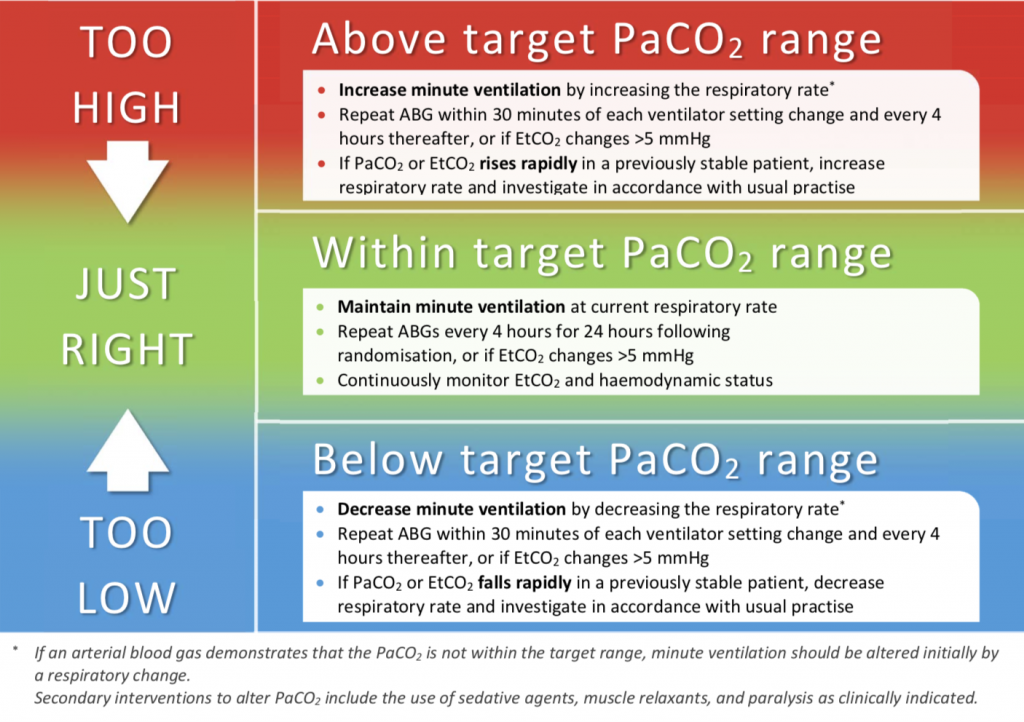
TAME Cardiac Arrest is a phase III, multi-centre, randomised, parallel-group, controlled trial to determine whether targeted therapeutic mild hypercapnia (TTMH) improves neurological outcome at 6 months compared to standard care (targeted normocapnia, TN) in resuscitated cardiac arrest patients who are admitted to the intensive care unit.
The hypothesis being evaluated is that, in resuscitated cardiac arrest patients admitted to ICU, TTMH improves neurological outcome at 6 months as assessed by the Glasgow Outcomes Scale Extended (GOSE) method. Fully eligible patients enrolled into this trial will be allocated to a TTMH protocol (target PaCO2 range 50 – 55 mmHg) or the Standard Care protocol (target PaCO2 range 35 – 45 mmHg) for 24 hours following randomisation. Patients in each group will be sedated to achieve moderate to deep sedation (a target Richmond Agitation Sedation Scale of -4). Arterial blood gas (ABG) and end-tidal carbon dioxide (ETCO2) levels will be measured at baseline and then used to guide respiratory rate adjustments of minute ventilation to remain within their target PaCO2 range. Importantly, ventilation management for all patients will be guided by ABG data assessed after adjustment to 37oC (alpha-stat) and, to ensure safety, the treating ICU physician can modify patients management, including the use of sedative agents, muscle relaxants and paralysis, as clinically indicated throughout the 24-hour intervention period. After the 24-hour intervention period, for patients allocated to TTMH, it is recommended that restoration of normocapnia occur slowly over the subsequent 4-hours (study time period 24 – 28 hours) facilitated by the use of ABG samples and ETCO2 levels to guide respiratory rate adjustments.